Capital Markets · Intelligence · Africa + Central Asia · 63 countries · 2026
Frontier Atlas / Index
The citation-gated intelligence layer for frontier capital — proven to cite the real regulation the old system fabricated around.
Client: Frontier Atlas (with MSIFS)
The challenge
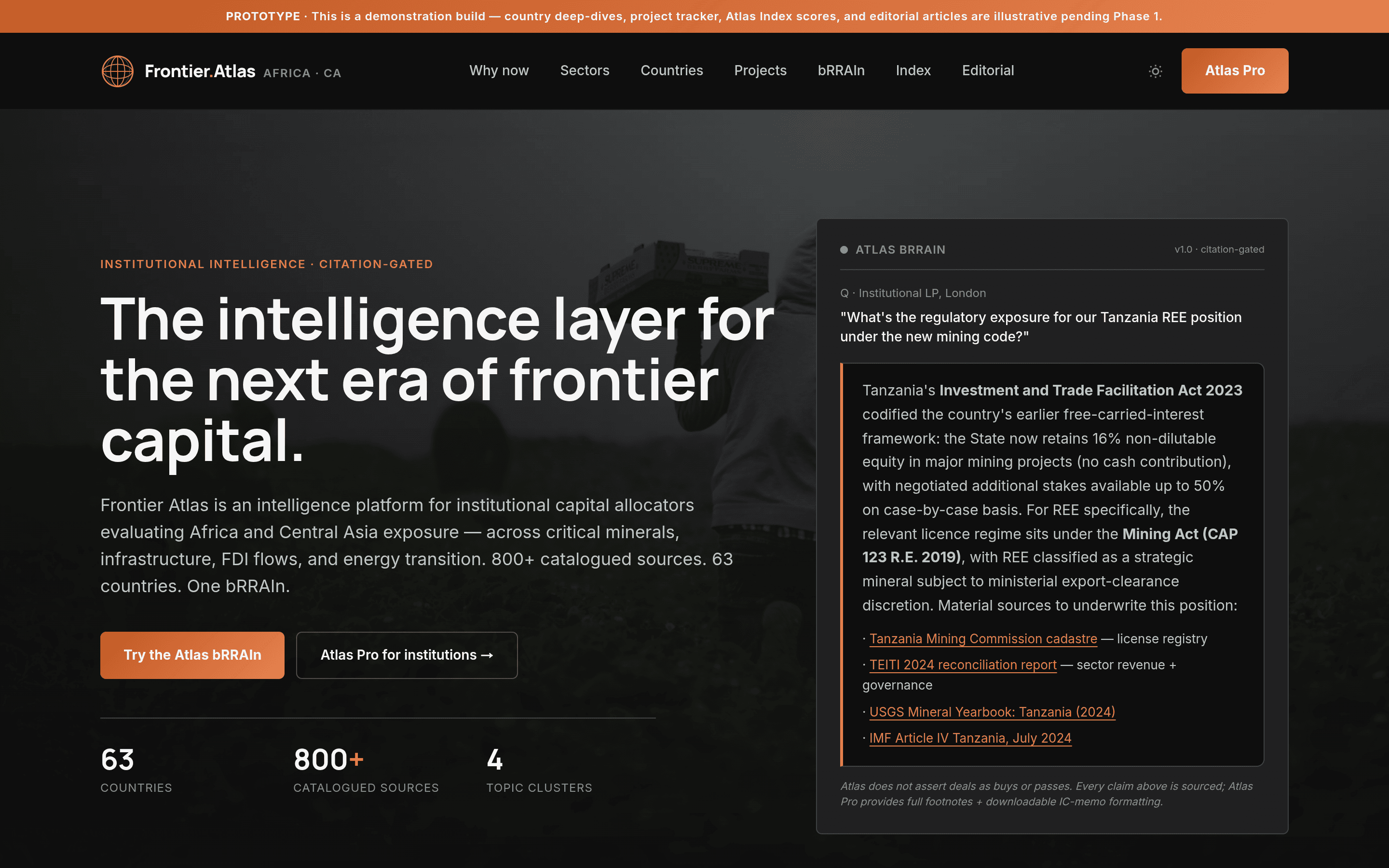
Institutional allocators evaluating critical minerals, infrastructure and FDI across Africa and Central Asia rely on fragmented intelligence — $50K Wood Mackenzie seats, $30K Eurasia Group subscriptions, and hundreds of free but uncatalogued government and DFI sources. No product combines both regions, the full topic stack, AI-native Q&A, citation rigour and a free public tier — and capital can't be committed without a defensible audit trail of sources. An audit even found the earlier prototype wasn't genuine RAG at all — so we rebuilt it as a real retrieval + citation-guard system.
What we delivered
The build
- 01Atlas Brain: a genuine RAG engine — Postgres full-text + trigram retrieval over a machine-readable source catalog, tier- and jurisdiction-aware — that answers with primary and anchor sources only, or declines rather than fabricate.
- 02A deterministic citation-guard (rule: never cite a source that isn't in the catalog), proven adversarially with a documented before/after failure test.
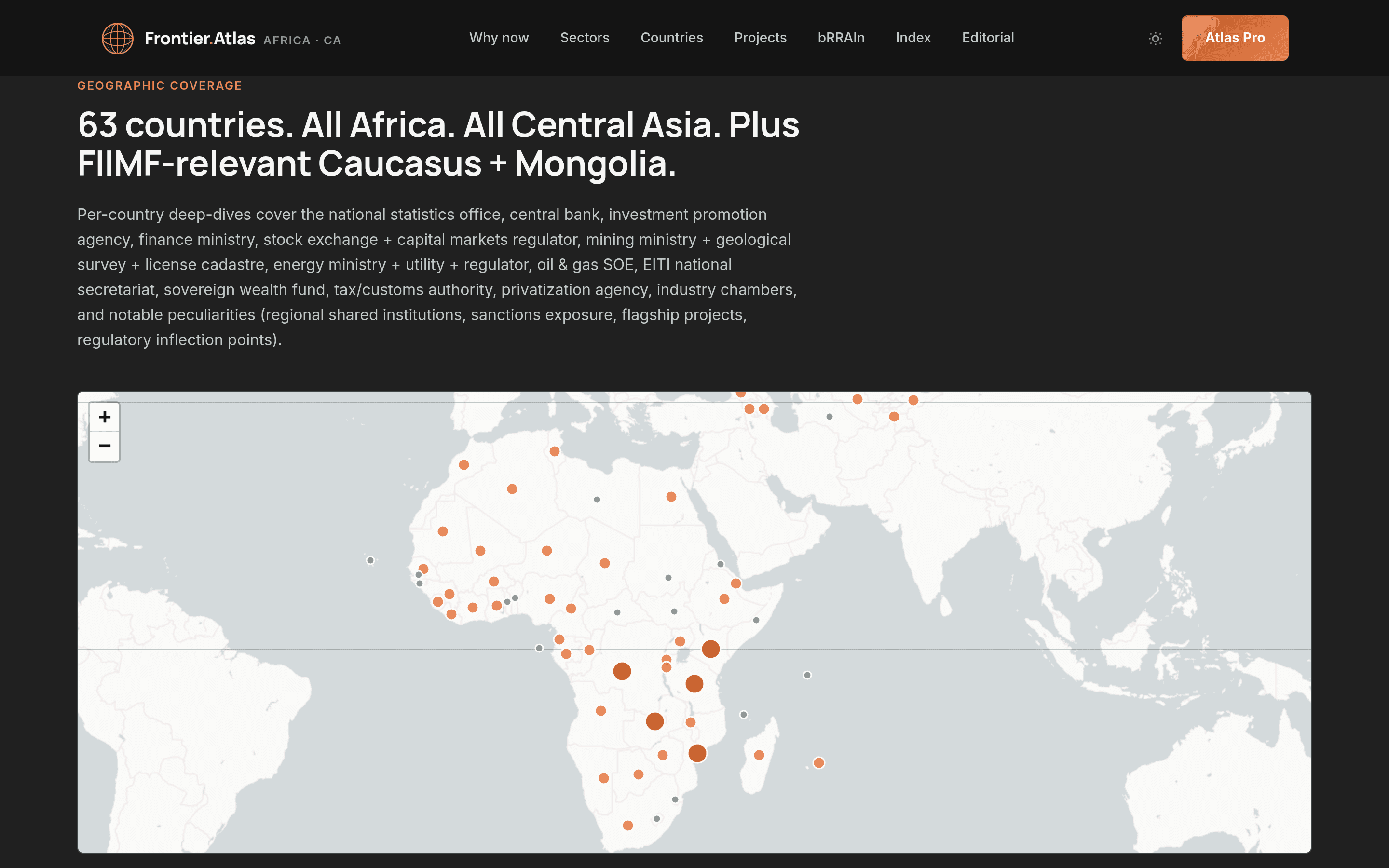
- 03A catalogued reference dataset of 800+ vetted sources across 63 countries and seven categories, with a live retrieval store seeded from the highest-tier primary sources (flagged for paywall, superseded status and effective date).
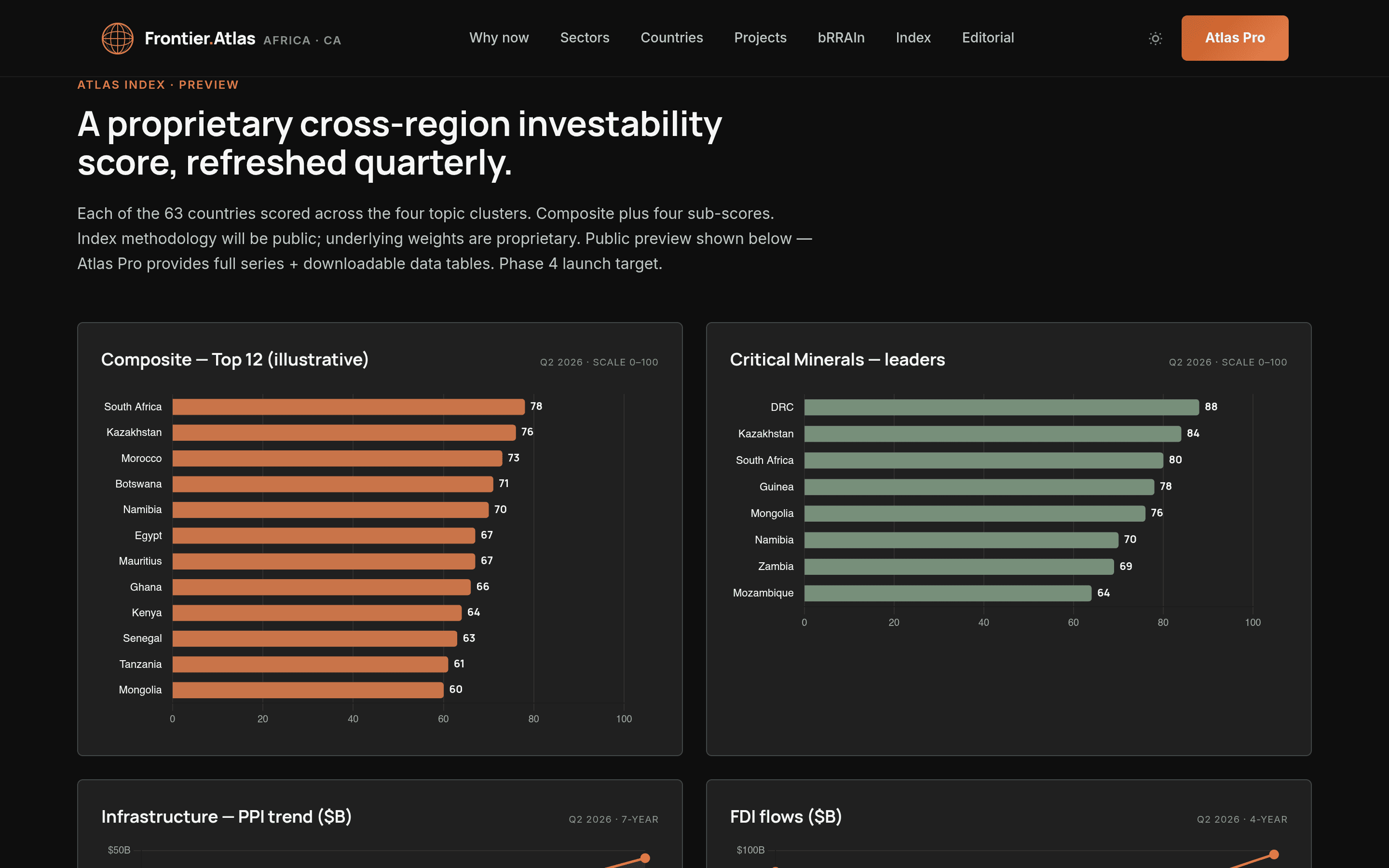
- 04A closed-loop editorial engine (articles drafted → citation-guarded → published → re-ingested as sources) and the Frontier Index — a cross-region investability score (preview).
Technology & AI
The technology behind it
Citation-gating enforced as a database invariant — the engine cannot cite a source that isn't in the vetted catalog, proven by a before/after test where it cites the real Tanzania regulation the old system fabricated around.
- ◆A genuine RAG rebuild: Postgres full-text + pg_trgm trigram retrieval over a machine-readable source catalog, tier- and jurisdiction-aware (a pgvector column is reserved for the semantic upgrade).
- ◆A deterministic citation-guard: a 3-state answerer that responds with primary sources, or declines — it will not fabricate a citation.
- ◆Proven adversarially: a Tanzania local-content question returns the real GN 563/2025 with its TanzLII PDF (the previous system invented a citation and missed the actual instrument); an out-of-catalog question declines with zero fabricated citations.
- ◆A catalog ETL (Claude extraction) that seeded the live retrieval store from vetted primary sources, and a closed-loop editorial engine where published articles are re-ingested as sources.
A credibility claim you can actually test — the citation guard is code, and its before/after failure case (Tanzania GN 563/2025) is documented. Not “trust the AI”; verify the invariant.
The outcome
Results
- ✓A genuine RAG engine with citation-gating enforced as a hard database invariant — verified by a documented before/after test (it cites the real GN 563/2025 the prior system fabricated around).
- ✓A catalogued reference dataset of 800+ vetted sources across 63 countries, with a live retrieval store seeded from the highest-tier primary sources.
- ✓Positioned with MSIFS as founding partner for industry convenings — Mining Indaba, Astana Finance Days, Africa CEO Forum.